Aug 22, 2026
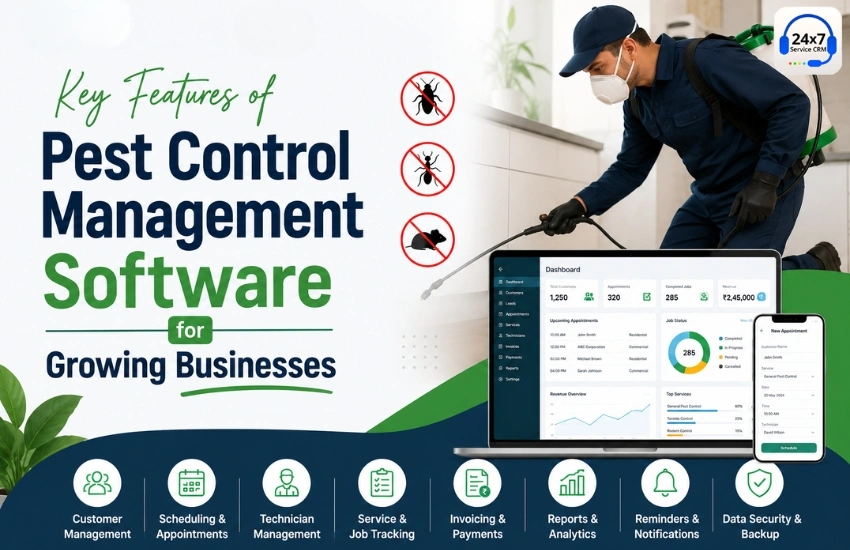
Pest control businesses manage multiple customer appointments, service locations, technicians, treatment schedules, invoices, follow-ups, and recurring service contracts every day. As a company grows, handling these activities through spreadsheets, notebooks, phone calls, and separate applications can become time-consuming and difficult to manage. Pest control business software provides a centralized solution for organizing service operations and customer information. It helps pest control companies manage everything from booking and scheduling to technician assignments, service history, billing, and customer follow-ups.
With the right pest control service management software, businesses can reduce manual work, improve scheduling, and provide a more consistent customer experience. When combined with a Service CRM, the software can also help businesses build stronger customer relationships and manage recurring service requirements more effectively.
Pest control management software is a digital platform designed specifically to help pest control companies manage their daily business and service operations.
Instead of maintaining customer information, appointments, technician schedules, service reports, and invoices in different places, businesses can manage these activities from one centralized system.
The software can support residential, commercial, industrial, and institutional pest control companies. It can also be useful for businesses offering recurring pest control treatments, annual contracts, inspections, and emergency services.
A small pest control business may initially manage appointments and customer records manually. However, as the number of customers and technicians increases, manual processes can create several challenges.
Common problems include:
Pest control service management software addresses these challenges by bringing essential operations into a single digital platform.
A centralized customer database is one of the most important features of pest control software.
Businesses can maintain customer names, contact information, service addresses, property details, service requirements, previous treatments, complaints, and payment information.
With a complete customer profile, employees can quickly access important information whenever a customer contacts the company.
A Service CRM can further improve customer management by maintaining communication history and service interactions in one place.
Pest control companies often manage numerous appointments every day. Scheduling these appointments manually can lead to overlapping jobs and unnecessary delays.
Pest control management software allows businesses to create and manage service appointments digitally. Managers can view upcoming jobs, assign time slots, and make schedule changes when required.
A centralized calendar makes it easier to coordinate customer requirements and technician availability.
Technicians are responsible for delivering services at customer locations. Managing multiple technicians across different areas can become challenging without proper software.
The system can help managers assign jobs based on technician availability, location, workload, and service requirements.
Technicians can access their assigned jobs and relevant customer information, helping them prepare before visiting the site.
Customers may contact pest control companies for different reasons, such as new treatments, follow-up visits, inspections, recurring services, or complaints.
Pest control business software can record these requests and convert them into service jobs.
Managers can monitor the status of each request and ensure that pending complaints are assigned and followed up on properly.
This creates a structured workflow from complaint registration to resolution.
Many pest control customers require regular treatments rather than one-time services.
Recurring service scheduling is therefore an important feature for growing pest control businesses.
Software can help companies create recurring appointments based on weekly, monthly, quarterly, or customized service intervals.
Automated reminders can also help teams prepare for upcoming visits and reduce the chances of missed treatments.
Maintaining a complete service history can help technicians understand what treatments were previously performed at a property.
The system can store information about previous visits, treatment types, service dates, technician remarks, customer feedback, and follow-up requirements.
When a technician visits the same property again, they can review previous records before beginning the service.
This can support more consistent and informed service delivery.
Paper service reports can be difficult to organize and retrieve. Digital reports provide a more convenient alternative.
Technicians can record completed work, treatment details, observations, recommendations, and customer remarks directly in the system.
The business can maintain these reports electronically for future reference.
Digital documentation can also make communication between technicians, managers, and customers more efficient.
Pest control businesses often provide recurring service contracts or annual maintenance agreements.
Managing contract start dates, expiry dates, service frequency, and renewal opportunities manually can be difficult.
Pest control service management software can help businesses track active contracts and upcoming renewals.
Automated reminders can alert teams when a contract is approaching its renewal date, giving them an opportunity to contact the customer in advance.
Businesses need an efficient way to manage pricing, quotations, and billing.
Pest control software can help employees create quotations for different services and convert approved jobs into invoices.
Businesses can also monitor payment status and outstanding amounts.
By connecting service activities with billing information, companies can reduce duplicate data entry and improve financial visibility.
Pest control services may require various materials, equipment, and treatment products.
Inventory management features can help businesses monitor stock levels, consumption, and usage across service jobs.
Managers can identify frequently used materials and plan purchasing accordingly.
Maintaining organized inventory records can also reduce the possibility of technicians arriving at a job without the required supplies.
Technicians spend much of their working day outside the office. Mobile access allows them to view assigned jobs and update service information while working at customer locations.
Depending on the software, technicians may be able to access:
This reduces the need for technicians to depend on paper documents or repeated calls to the office.
Follow-ups are an important part of pest control service management.
Software can provide reminders for upcoming appointments, recurring treatments, contract renewals, pending payments, and customer follow-ups.
Automation reduces the amount of manual coordination required from office staff.
It can also help businesses maintain regular communication with customers.
Growing businesses need accurate information to understand their performance.
Pest control management software can generate reports related to:
These reports can help business owners identify operational problems and make better decisions.
A Service CRM can connect customer information with service operations.
For example, employees can see a customer's previous treatments, complaints, service appointments, contracts, and communication history from a centralized profile.
This allows businesses to provide more personalized support and respond to customer questions with better context.
A strong customer relationship system can also help identify opportunities for repeat services and contract renewals.
Implementing pest control business software can provide several advantages:
Automating repetitive administrative tasks allows employees to focus on customer service and business development.
Centralized scheduling helps reduce appointment conflicts and improves technician utilization.
Employees can quickly access customer and service information when handling requests.
Managers can monitor jobs from registration through completion.
Recurring service reminders and contract management help businesses maintain regular customer engagement.
Digital records reduce dependence on manual registers and spreadsheets.
Reports and dashboards provide management with useful operational information.
Before selecting a solution, pest control companies should evaluate their specific requirements.
Important features to consider include:
The FSM Software Service CRM should also be easy for employees and technicians to use. A complicated system can reduce adoption and make implementation more difficult.
As pest control companies grow, managing customers, technicians, appointments, recurring treatments, contracts, and billing manually becomes increasingly challenging.
Pest control business software provides a centralized way to organize these activities and improve operational efficiency. With features such as scheduling, technician management, service history, recurring appointments, digital reports, contract management, billing, and inventory tracking, businesses can create a more structured service workflow.
Pest control service management software becomes even more valuable when integrated with a Service CRM, allowing companies to connect service operations with customer relationships.
For growing pest control businesses, adopting the right software can reduce administrative work, improve service coordination, strengthen customer communication, and provide the visibility needed to scale operations more effectively.









Instant free download from Play Store and Apple. Service CRM is one the best Software or Application for field service management. You can book a demo Online.